Participatory photography as a tool to find what we value in the local community
How do we build more participative and socially aware communities?
We start by listening to those who live there.
In 2021, the Neighbourhood Museum pilot project began – an active citizenship project based on personal artistic intervention, where students from participating schools are invited to examine and record their perspective on the tangible and intangible heritage of their community.
Through participatory photography, young people are challenged to (re)discover their ‘Neighborhood’. The creation of exhibition content acts as an artistic research tool that allows young people to appreciate their community whilst reinforcing their creative autonomy.
The challenge
Discover, record, interpret and revitalize cultural heritage through photography!
Promote...
tangible and intangible heritage, increasing participants' sense of belonging and identity.
Strengthen...
active citizenship in educational contexts - students, educators, and others involved.
Exercise...
the use of digital and artistic tools to promote intergenerational and intercultural dialogue.
Developing...
personal, family, and community skills, such as media literacy, through the creation of participatory projects;
Methodology in 8 steps
Our process adapts to each context, but follows a methodology of immersion, discussion, personalization, intervention and exposure
1st session
> Presentation > Heritage and Participatory Photography > Challenge: think about the theme
2nd / 3rd sessions
> Ways of looking at a photograph > Photography exercise > Thematic exploration
4th session
> Field trip
5th / 6th session
> Artistic intervention on the photos > Photo captioning
7th session
> Exhibition construction
8th session
> Setting up the exhibition > Vernissage > Celebration
Discovering tangible and intangible heritage through participatory photography
Cultural Heritage can be defined as a tangible and/or intangible legacy that constitute the culture of a group or people.
Just as in a museum we find works of value (pictures, paintings, objects, etc.) – in the Neighbourhood Museum we find what we value in the community – the churches, the gardens, the beach, the people, the stories, etc.
Material cultural heritage is associated with material elements and is therefore made up of tangible and concrete elements, whether movable or immovable, for example, works of art and churches.
Intangible cultural heritage relates to the knowledge, skills, beliefs, practices and customs of communities.
And then there’s the natural heritage, such as the forests, the coast, the sea or lake.
Editions in progress
NEIGHBORHOOD MUSEUM Between Generations
Participatory photography as a tool for education, expression, and intergenerational citizenship
Project where the population of the Alcântara and Ajuda territories are invited to investigate what they value most in the community – the cultural, human, natural, tangible, and intangible heritage of their community.
NEIGHBOURHOOD MUSEUM 5th edition in Oeiras
Participatory photography as a tool to find what we value in the local community
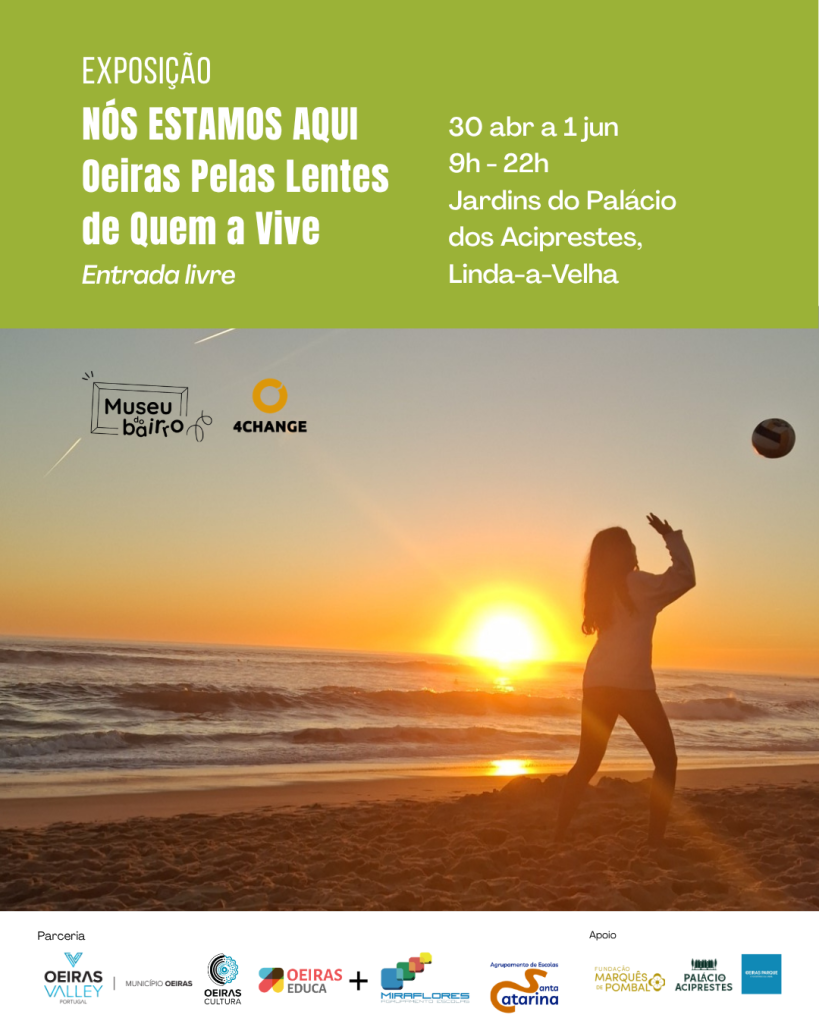
The Neighbourhood Museum is art and an invitation, where students and teachers use participatory photography to investigate the tangible and intangible heritage of the municipality of Oeiras.